Pirate Clipart: Black Pirate Animal Svg for Creative Projects
When you're designing for children or families, the visual language needs to speak immediately. It should be playful, memorable, and versatile enough to work across a dozen different formats without losing its charm. That's exactly what makes the Pirate Clipart, Black Pirate Animal Svg collection so useful. It's not just a set of cute animals dressed in pirate costumes—it's a cohesive design system built around a specific aesthetic that balances whimsy with clean, professional execution.
What This Collection Actually Contains
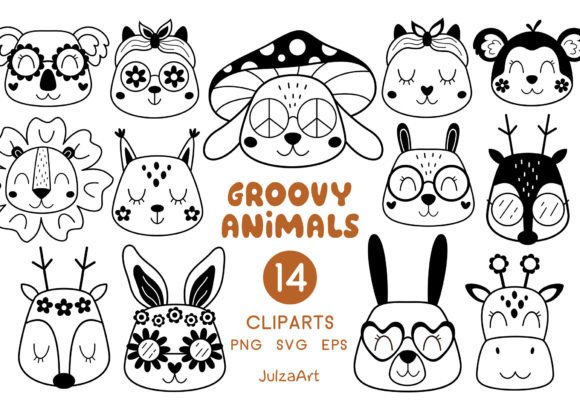
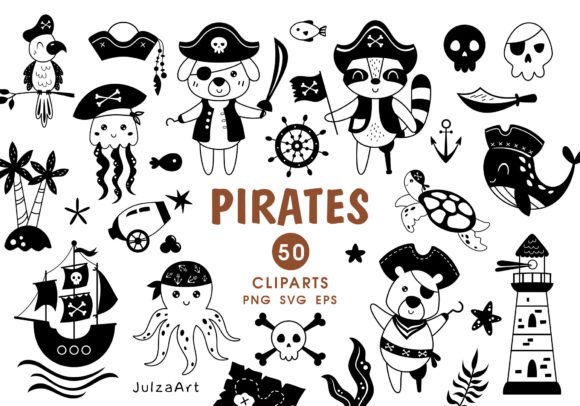
At its core, this is a black and white graphic set featuring twelve distinct animal characters—lion, dog, bear, bunny, raccoon, whale, octopus, turtle, jellyfish, fish, parrot—plus additional vector pirate elements like ships, flags, treasure chests, and nautical accents. The visual style is line-based, relying on bold outlines and minimal fill to create characters that feel hand-drawn but digitally refined. Think of it as a premium font equivalent in the clipart world: polished enough for commercial use, approachable enough for personal projects.
The animals themselves have a specific personality. They're round, expressive, and slightly oversized in the head—classic proportions for nursery art and children's branding. Each character carries a pirate detail: a bandana, an eye patch, a tricorn hat. These details are small but consistent, which matters more than you'd expect. Consistency in character design is what separates a professional illustration set from a collection of mismatched doodles.
You receive the files in multiple formats: one EPS file with all elements at 300 DPI, plus 50 individual PNG files with transparent backgrounds and 50 SVG files. The PNG files work immediately in most design software. The SVG files are where the real flexibility lives—they scale infinitely without quality loss, which makes them ideal for everything from web graphics to large-format printing.
Where These Graphics Actually Work
The practical applications are broader than the typical "pirate party" framing suggests. Yes, this collection shines for pirate birthday party decor—invitations, banners, cupcake toppers, favor tags. But it also works well in contexts people don't immediately consider.
Nursery art and baby cards are a natural fit. The black-and-white palette is intentional here. Newborns respond to high-contrast imagery, and monochrome designs integrate easily into existing nursery color schemes without clashing. A set of these animals printed on a poster or canvas becomes wall art that parents actually want to display—not just themed decor that gets packed away after the party.
For small business owners selling on platforms like Etsy or Shopify, these assets solve a real problem. Creating custom children's clothing, bags, pillows, or mugs requires illustration work that's expensive to commission and time-consuming to produce in-house. A well-organized clipart set with transparent PNGs and scalable SVGs lets you build product lines quickly. You can layer the characters onto mockups, adjust sizing for different products, and maintain visual consistency across your entire catalog.
Bloggers and content creators in the parenting, education, or lifestyle space can use these graphics for social media posts, Pinterest pins, blog headers, and downloadable printables. The SVG files are particularly useful here because they load cleanly at any resolution—critical for responsive web design where images need to look sharp on both mobile screens and desktop monitors.
How to Evaluate Fit for Your Project
Before committing to any design asset, it's worth asking whether the style actually serves your project's goals. This collection has a specific visual voice: playful, rounded, monochrome. That voice works beautifully for certain contexts and poorly for others.
If your brand identity leans toward modern minimalism with a sophisticated edge, these characters might feel too juvenile. If you're designing for a children's hospital, a kids' clothing line, a family-friendly restaurant, or a parenting blog, the style is nearly perfect. The key is matching the visual hierarchy of your project with the personality of the assets.
Think about font pairing as an analogy. Just as you'd pair a display font with a clean sans serif font for body text, you'd pair these playful illustrations with typography that doesn't compete for attention. A rounded sans serif or a friendly handwritten font complements the characters. A sharp geometric typeface or an ornate script font would create visual tension that undermines the overall cohesion.
Test the assets at the actual size you'll use them. A character that looks charming at two inches wide on an invitation might feel cluttered when scaled to fill a t-shirt front. The SVG format handles scaling technically, but visual weight changes with size—what reads as a cute detail at small scale can dominate a design at large scale.
Working With the File Formats
The included EPS file opens in Adobe Illustrator, Affinity Designer, or similar vector editors. This is where you'd go to customize colors, adjust line weights, or combine elements into new compositions. If you're comfortable with vector editing, the EPS gives you full control.
The 50 PNG files with transparent backgrounds are the workhorses for most users. They drop directly into Canva, Photoshop, PowerPoint, or any design tool that handles transparency. No conversion needed, no background removal required. At 300 DPI, they're print-ready for standard projects—greeting cards, posters, stickers, and similar applications.
The 50 SVG files serve users who need resolution independence or want to edit paths without a full vector editor. Many web-based design tools now support SVG import, making these files increasingly accessible even to non-technical users.
Commercial Considerations
For anyone using these assets commercially—whether you're selling printed products, creating client work, or building a brand—review the licensing terms before you start. Most clipart licenses distinguish between personal and commercial use, and some restrict the number of end products or the types of media. Understanding these boundaries upfront prevents problems later.
The commercial font and asset market has matured significantly. Buyers expect clear licensing, organized file structures, and formats that work across platforms. This collection delivers on all three counts. The file organization alone—separating PNGs, SVGs, and the master EPS—saves time when you're managing multiple projects simultaneously.
Ultimately, the value of any creative font or illustration set comes down to how much usable work it produces. A single character from this collection could appear on a baby shower invitation, a nursery wall print, a children's t-shirt, a social media campaign, and a blog's sidebar—and look intentional in each context. That kind of versatility is what makes design assets worth the investment, not the number of files in the download folder.